The indefinte article a/an is the same for all genders: a girl, a cat, an eraser, an egg.
The indefinte article has no plural form: a girl - girls, a cat - cats, an egg, eggs.
We use an if the following word starts with a vowel sound:
- an egg, an envelope, an apple.
We use a if the following word starts with a consonant sound:
- a cat, a dog, a door, a girl
We must use the indefinite article a/an before phrases of time and measurements (per week/weekly):
- We have Spanish classes 3 times a week.
- I go on holiday once a year.
- This Ferrari can do 350 kilometres an hour.
- Oranges are $1 a kilo.
Before phrases of jobs:
- George is an engineer.
- I'm a teacher.
Before phrases of nationality:
- Elton John is an English singer
- Antonio Banderas is a Spanish actor
Half/Quite:
- Stella needs half a kilo of sugar
- This is quite a good song
So far, so good. Further on, I'll explain about the article the.
Tuesday, September 9, 2014
Friday, September 5, 2014
Simple Future Be Going to + Will Future Tenses

After all this time (and I'm really sorry about that), I'm back! I'd intended to write this blog in both languages, although my first intention was to write it in English but some students have asked to write in Portuguese, just like the coaching sessions that we have at school. So here we go, and I'm going to explain about Simple Future - Be Going To.
It's used to talk about plans, intentions. Going to + verb in the infinitive form often emphasizes this idea of intention or decision, got it?
1. She's going to play the guitar. (It's a planned action in the future).
2. He studied a lot. He's going to do the test. (It's certain that this is going to happen).
3. This afternoon, I'm going to write that essay.
Will - Future is used to:
1) Future actions happen without the speaker's intention: The stars will shine tonight.
2) Predictions, assumptions: I think that your favorite band will play in Brazil in October.
3) Spontaneous actions: Hang on! I'll have a word with you.
4) Sudden decisions: By the way, I'll go to the Vamp Party with you.
Here you are some links to practice:
Will or Be Going To (1)
Will or Be Going To (2)
Will or Be Going To (3)
See you all next post!
Thursday, April 18, 2013
How Much, How Many

Hello, everybody!
Hoje a explicação é sobre How Much/How Many.Parece difícil, mas a explicação e a aplicação é simples, vamos lá:
How much é usado para todos os singulares e contáveis, incluindo líquidos sem seus containeres. Ex.:
- How much wine do we need for tonight?
- How much bread do we have for the breakfast?
- How much cheese is there in the fridge?
- How much milk are you going to buy?
- How much money do you have?
- How much ham would you like?
- How much chocolate would you like?
- How much lettuce is there?
How many é usado para todos os plurais e contáveis. Ex.:
- How many oranges do we need?
- How many cartons of orange juice are there?
- How many bottles of wine do we have?
- How many cartons of milk are there?
- How many eggs are there in the fridge?
- How many apples do you need?
- How many bars of chocolate would you like?
- How many heads of lettuce are there?
Lembrando que contáveis são tudo o que você pode contar: an apple, a pear, an egg, a carrot, a tomato...
Incontáveis são o que não é possível contar, como cheese, ham, salami (a piece, a pound / two, three pieces/ two, three pounds...), sugar, money... e outros.
Para atividades extras, acesse How Much/ How Many 1, How Much/ How Many 2, How Much/ How Many 3, How Much / How Many 4, e How Much/ How Many 5.
Tuesday, April 2, 2013
How to Make Your Writing Really Beautiful - Part 2
Já publicada a parte 1 de How to Make Your Writing Really Beautiful, segue aqui a continuação. Esse post havia sido publicado há 5 anos atrás, mas eu o revisei e estou republicando-o, por isso manterei a explicação no idioma original. Dúvidas, deixem comentários.
This time, I'll show you some conjunctions that are used to express a "but" relation.
At any rate > whatever happens or even something you say that you are going to say something more exactly
However > Adverb. It means despite this
On the other hand > It used when you are comparing two different facts or two opposite ways of thinking
Although > Conjunction. Despite the fact that, or but
And there are other conjunctions such as: actually, anyhow, as a matter of fact, even so,, even though, in spite of this/that, nevertheless, on the contrary.
Next step, I'll show you more words to emphasize the best writing. I hope to have helped you all.
This time, I'll show you some conjunctions that are used to express a "but" relation.
At any rate > whatever happens or even something you say that you are going to say something more exactly
- Well, I won't go home by bus, at any rate.
- I'm not sure if they liked my project. At any rate, some of them went out from room without I could finish it.
However > Adverb. It means despite this
- I'm thinking about taking a Philosophy course. However, Astronomy looks fascinating.
- He bought a new video game, however, he's thinking about saving money to buy the Playstation 4.
On the other hand > It used when you are comparing two different facts or two opposite ways of thinking
- I'd like to stay at home because it's comfortable, but on the other hand I'd like to go out with my friends tonight. What should I do?
- I like my job, but on the other hand I need another one which pays more.
Although > Conjunction. Despite the fact that, or but
- I decided to leave home for work earlier, although the weather is really bad.
- Although I have spent most part of my money on a new blouse, I saved something to have dinner with my friend tonight.
And there are other conjunctions such as: actually, anyhow, as a matter of fact, even so,, even though, in spite of this/that, nevertheless, on the contrary.
Next step, I'll show you more words to emphasize the best writing. I hope to have helped you all.
English Central Videos
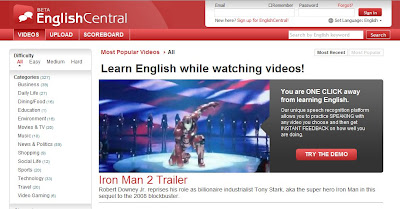
So, to start with, ops, para começar, quero indicar à todos os estudantes deste idioma maravilhoso, o site English Central. Há milhares de videos, em que é possível praticar audio (listening), speaking, pronunciation, e vocabulário. É um site bastante dinâmico, basta apenas ter um bom headphone com microfone.
No English Central há videos para 3 níveis: fácil, média dificuldade e alta dificuldade. É uma excelente ferramenta, tanto para os que estão aprendendo até mesmo para professores, nós que falamos o idioma, mas vivemos no Brasil, e a prática e treino devem ser constantes.
No English Central há videos para 3 níveis: fácil, média dificuldade e alta dificuldade. É uma excelente ferramenta, tanto para os que estão aprendendo até mesmo para professores, nós que falamos o idioma, mas vivemos no Brasil, e a prática e treino devem ser constantes.


Subscribe to:
Posts (Atom)